
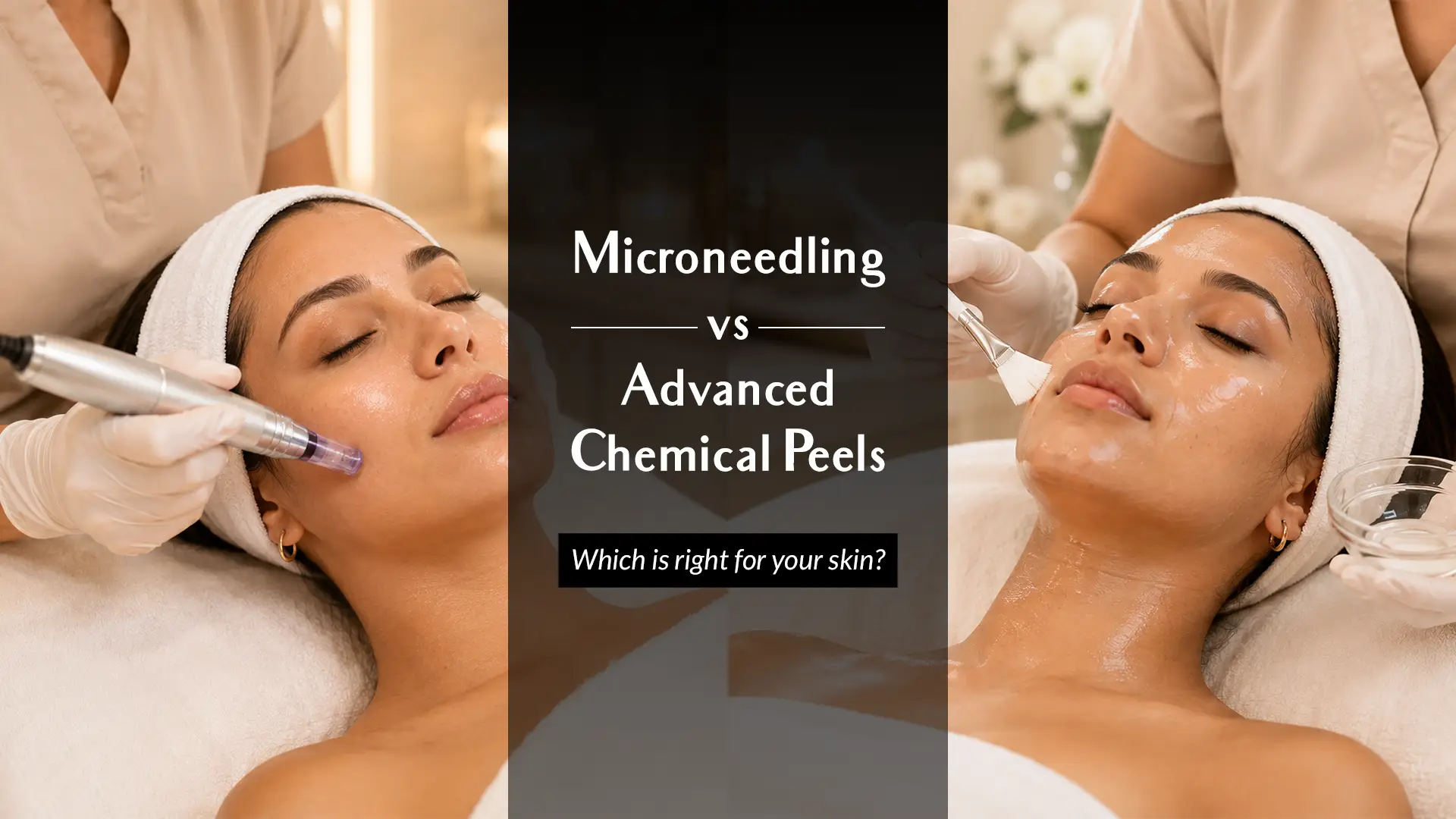
If you are looking to improve acne scars, pigmentation, uneven skin texture, fine lines or simply achieve healthier-looking skin, two treatments you are likely to come across are microneedling and advanced chemical peels.
Both are powerful professional skin-renewal treatments. Both can improve the appearance and quality of your skin. And in some cases, both may even form part of the same long-term treatment plan.
But they work in very different ways.
At Enrich by Naseema in Lusaka, we believe choosing an advanced skin treatment should never be about following the latest trend. It should begin with understanding your skin, identifying what you actually want to improve and selecting the treatment most suited to those concerns.
So, when it comes to microneedling vs chemical peels, which one should you choose?
Let’s break it down.
Microneedling vs Chemical Peels: The Quick Answer
If you want the simplest comparison:
Microneedling works primarily by stimulating your skin’s natural repair and collagen-building response.
Chemical peels work primarily by using carefully selected exfoliating solutions to resurface layers of the skin.
That difference influences the types of skin concerns each treatment may be particularly useful for.
Microneedling is commonly used for concerns such as acne scarring, enlarged-looking pores, uneven texture, fine lines and overall skin quality, while chemical peels can be particularly useful for pigmentation, dullness, surface texture, uneven tone and certain types of acne-related concerns.
The answer, however, is rarely as simple as choosing one from a list.
Your skin may benefit more from one treatment, a series of treatments, or a professionally planned combination.
What Is Microneedling?
Microneedling is a minimally invasive skin treatment that uses very fine needles to create controlled microchannels in the skin.
These tiny, controlled injuries stimulate the skin’s natural healing response and encourage the production of collagen and elastin, proteins that play an important role in the skin’s structure, firmness and smoothness.
As the skin gradually remodels, clients may notice improvements in its texture, firmness and overall appearance.
Unlike a treatment designed primarily to exfoliate the surface, microneedling works by encouraging renewal from within the skin.
What Can Microneedling Help With?
Depending on your skin and the treatment selected, microneedling may be recommended to improve the appearance of:
- Acne scars
- Uneven or rough skin texture
- Enlarged-looking pores
- Fine lines
- Uneven skin tone
- Mild skin laxity
- General skin quality
- Certain forms of pigmentation
Results generally develop gradually rather than overnight because collagen remodelling takes time. Improvement can begin within weeks, while fuller results may take several months to become visible.
What Is RF Microneedling?
RF Microneedling, or Radiofrequency Microneedling, takes the basic principle of microneedling further.
In addition to creating controlled microchannels, the treatment delivers radiofrequency energy into targeted layers of the skin.
This controlled energy can support deeper tissue remodelling and additional collagen stimulation.
At Enrich by Naseema, RF Microneedling forms part of our advanced skin treatment offering and is used for clients whose concerns may include texture, scarring, fine lines, pores and skin firmness.
Research has found RF microneedling to be useful across several aesthetic concerns, particularly acne scarring and skin rejuvenation, although treatment protocols and individual responses vary.
What Is an Advanced Chemical Peel?
An Advanced Chemical Peel approaches skin renewal differently.
Instead of creating microchannels, a professionally selected chemical solution is applied to the skin to create controlled exfoliation.
Different peel formulations and strengths penetrate to different depths. This is why the term “chemical peel” can describe treatments ranging from relatively superficial exfoliation to significantly more intensive resurfacing.
As the treated layers shed and the skin renews, a chemical peel can help reveal a smoother, brighter and more even-looking complexion.
What Can Advanced Chemical Peels Help With?
Depending on the peel selected, they may be used to improve the appearance of:
- Hyperpigmentation
- Post-acne marks
- Uneven skin tone
- Dullness
- Rough skin texture
- Fine lines
- Congestion
- Certain types of acne
- Sun-related pigmentation
- General skin clarity
At Enrich by Naseema, our advanced peel options vary in formulation, purpose and intensity. This means the right peel should be selected according to your skin, rather than simply choosing the strongest treatment available.
Microneedling vs Chemical Peels: Key Differences
| Microneedling / RF Microneedling | Advanced Chemical Peel | |
|---|---|---|
| How it works | Creates controlled microchannels to stimulate skin repair and collagen | Uses chemical exfoliation to resurface selected layers of skin |
| Main focus | Collagen, texture and structural renewal | Surface renewal, tone and pigmentation |
| Often considered for | Acne scars, pores, fine lines, texture, firmness | Pigmentation, dullness, uneven tone, congestion, surface texture |
| Results | Develop gradually as collagen remodels | Surface brightness and texture changes may appear sooner |
| Treatment depth | Can target deeper layers, particularly with RF | Depends greatly on peel formulation and depth |
| Downtime | Often several days, depending on treatment intensity | Can vary from minimal to more significant peeling and recovery |
| Number of treatments | A series may be recommended | A series may also be recommended |
| Best choice? | Depends entirely on your skin concern | Depends entirely on your skin concern |
Neither column is automatically better than the other.
That is the most important point.
Which Is Better for Acne Scars?
This depends on what you mean by “acne scars.”
Clients often use the term acne scarring to describe both actual textural scars and the dark marks left behind after breakouts, but they are not the same thing.
Depressed or Pitted Acne Scars
For atrophic scars such as rolling, boxcar or certain pitted acne scars, microneedling — particularly RF Microneedling — may be a stronger option because the treatment stimulates collagen remodelling within the skin.
Microneedling is commonly used professionally for acne scarring, and research into RF microneedling also supports its usefulness for atrophic acne scars.
Dark Marks After Acne
Brown or darker marks that remain after acne are often post-inflammatory hyperpigmentation rather than true scars.
For pigmentation that sits closer to the surface, a carefully selected chemical peel may form part of a treatment plan designed to improve tone and clarity.
In Simple Terms
Pitted or textural acne scars: Microneedling or RF Microneedling may be preferred.
Post-acne pigmentation: An Advanced Chemical Peel may sometimes be more appropriate.
Both scarring and pigmentation: A professionally planned combination may be worth considering.
Which Is Better for Pigmentation?
Chemical peels can be an excellent option for certain types of pigmentation because they exfoliate damaged surface cells and encourage skin renewal.
But pigmentation is complicated.
Not every dark mark has the same cause, and treating pigmentation too aggressively can sometimes make it worse.
This is especially important for clients with medium to deeper skin tones. Chemical peels can be used safely across different complexions, but the type and depth of peel and the experience of the practitioner matter greatly because inappropriate treatment can cause unwanted pigment changes.
This is one reason we strongly recommend having your skin assessed rather than selecting an advanced peel based solely on its name or strength.
Which Is Better for Enlarged Pores and Uneven Texture?
Both treatments may improve the appearance of texture, but they approach the problem differently.
Microneedling encourages collagen remodelling beneath the surface, which can help improve the appearance of enlarged pores and uneven texture over time.
Chemical peels exfoliate and resurface the skin, which can improve roughness and leave the complexion looking smoother and brighter.
If the concern is primarily superficial roughness and dullness, a chemical peel may be sufficient.
If the concern involves more significant textural irregularity, pores or scarring, microneedling or RF Microneedling may be considered.
Which Is Better for Fine Lines and Skin Firmness?
For concerns involving skin structure, firmness and fine lines, RF Microneedling may have an advantage.
Microneedling already stimulates the body’s collagen-building response, while RF Microneedling adds controlled radiofrequency energy at selected depths.
Evidence around RF Microneedling supports its role in collagen remodelling and skin rejuvenation, with improvements continuing gradually after treatment.
Chemical peels can also improve the appearance of fine lines, particularly when those lines are associated with superficial skin damage, but the mechanism is different.
Which Treatment Gives Faster Results?
This is another important difference between microneedling and chemical peels.
Chemical peels may produce a more immediately noticeable change in surface brightness, smoothness and clarity once the skin has completed its initial recovery.
Microneedling tends to be more gradual.
Because part of the goal is collagen remodelling, the improvements continue developing in the weeks and months following treatment.
So if you are asking:
“Which gives the fastest glow?”
A suitable peel may often provide faster visible surface renewal.
If you are asking:
“Which helps rebuild and improve the skin over time?”
Microneedling may be the more relevant conversation.
What About Downtime?
Downtime depends heavily on the exact treatment.
After microneedling, the skin may appear red or darker, feel warm or sensitive and develop some temporary swelling. These effects commonly settle over several days, although recovery varies by treatment intensity and individual skin response.
Chemical peel recovery varies even more because peel depths differ significantly.
A lighter peel can have relatively little downtime, while stronger peels may involve visible peeling, flaking, sensitivity and a longer healing period. The American Academy of Dermatology notes that healing can range from around a day for very light peels to two weeks or longer for deeper treatments.
When planning either treatment, do not book purely according to how much downtime you hope to have.
Ask your therapist what to realistically expect from the specific treatment being recommended for you.
Can Microneedling and Chemical Peels Be Combined?
Yes — but that does not necessarily mean performing them together at the same appointment.
For some skin concerns, the most effective plan may involve using both treatments at different stages.
For example, one treatment may focus on deeper textural concerns while another addresses surface pigmentation or tone.
Microneedling is also sometimes used alongside other modalities in professionally planned acne-scar treatment programmes.
The important word is planned.
Advanced treatments should be spaced appropriately so that the skin has time to recover and the risk of irritation or complications is minimised.
At Enrich by Naseema, the objective should never be to fit as many treatments as possible into a routine.
It is to create the right treatment journey for your skin.
Can You Have Microneedling If You Have Active Acne?
Not necessarily.
If you currently have inflamed, painful or infected acne lesions, microneedling may need to be postponed until the active breakout is appropriately managed.
It is more advisable to delay microneedling when there is an active skin infection or deep, painful or pus-filled acne.
Depending on the type of acne and your skin condition, your therapist may recommend a different approach first.
What About Darker Skin Tones?
This deserves particular attention when choosing any advanced skin treatment.
Microneedling is widely used across different skin tones, and the American Academy of Dermatology describes both traditional microneedling and RF Microneedling as options that can be used across skin tones when appropriately performed.
Chemical peels can also be safely performed on deeper skin tones, but the treatment must be selected carefully.
Overly aggressive exfoliation or an inappropriate peel can trigger post-inflammatory hyperpigmentation or hypopigmentation, which is why assessment, treatment selection and aftercare matter so much.
At Enrich, your complexion should never be treated according to a one-size-fits-all protocol.
Microneedling or Chemical Peel? Choose According to Your Main Concern
If your primary concern is:
Acne Scarring
Consider discussing Microneedling or RF Microneedling.
Enlarged-Looking Pores
Microneedling may be particularly useful.
Skin Firmness
Discuss RF Microneedling.
Fine Lines
Either may be suitable depending on whether the concern is primarily structural or superficial.
Pigmentation
A carefully selected Advanced Chemical Peel may be considered.
Post-Acne Dark Marks
Chemical peels may form part of the treatment strategy.
Dull, Rough Skin
A professional peel may provide effective surface renewal.
Uneven Texture
Either treatment may be appropriate depending on the cause and depth of the textural concern.
Multiple Concerns
Your best option may be a treatment programme rather than one individual treatment.
So, Which Is Better: Microneedling or Chemical Peels?
There is no universal winner.
And that is actually good news.
It means your treatment does not have to be chosen according to what is trending on social media or what worked for someone else’s skin.
If your concern is deeper texture, acne scarring, pores, collagen loss or firmness, Microneedling or RF Microneedlingmay be more appropriate.
If your main concerns are pigmentation, dullness, uneven tone or surface texture, an Advanced Chemical Peel may be the better starting point.
And if you have several concerns at once, a personalised treatment programme may incorporate both.
The best advanced skincare is not about choosing the strongest treatment.
It is about choosing the right treatment for your skin.
Advanced Skin Treatments at Enrich by Naseema
At Enrich by Naseema in Lusaka, our advanced skin treatment offering includes options such as:
- Plain Microneedling
- Microneedling with customised serums
- RF Microneedling
- Microneedling with PRF
- Advanced Chemical Peels
- BioRePeel
- HydraFacial
- Other specialised skin and facial treatments
Our approach begins with understanding your skin and your goals so that we can recommend a treatment plan suited to you.
Whether your concern is acne scarring, pigmentation, texture, fine lines, enlarged pores or simply improving your overall skin quality, you do not have to work out the answer alone.
Not Sure Which Treatment Your Skin Needs?
Book a skin consultation at Enrich by Naseema and let our team help you understand your options.
We will assess your skin, discuss your concerns and recommend whether Microneedling, RF Microneedling, an Advanced Chemical Peel or another treatment may be more appropriate for your goals.
Your skin is individual. Your treatment plan should be too.
Book Your Skin Consultation
Enrich by Naseema
22 Nangwenya Road, Rhodes Park, Lusaka
Call: +260 97 337 2652
Email: info@enrichbynaseema.com
Frequently Asked Questions
Neither treatment is universally better. Microneedling may be preferred for concerns involving acne scars, pores, texture and collagen, while chemical peels may be particularly useful for pigmentation, dullness, uneven tone and surface renewal. Your skin should be assessed before deciding.
For depressed or pitted acne scars, microneedling or RF Microneedling may be more appropriate because they encourage collagen remodelling. Chemical peels may be useful when the main concern is post-acne pigmentation or more superficial irregularities.
A professionally selected chemical peel may be useful for certain pigmentation concerns, although the cause of the pigmentation and your skin type need to be considered carefully.
RF Microneedling adds radiofrequency energy to the microneedling process, allowing treatment at targeted depths and providing additional stimulation for collagen remodelling. Whether it is the better option depends on your treatment goals.
Both Microneedling and Advanced Chemical Peels may require a series of treatments. The number and spacing of sessions depend on your skin concern, treatment type, response and goals.
Both may form part of the same long-term skincare programme, but treatment timing should be professionally planned. They should not simply be combined without considering recovery time, your skin condition and treatment intensity.
Yes. Sun protection is especially important following professional resurfacing and skin-renewal treatments. Follow the aftercare instructions provided by your therapist and use appropriate broad-spectrum SPF.